Neuigkeiten & Einblicke
Kurz gemeldet
Kurze Updates zu Deals, Regeln und Netzbewegungen in der Ladebranche
Octopus Energy closed its majority stake in Uplight, and bought 8.5 GW of flexible load with it
Octopus Energy has closed its majority investment in Uplight, a US platform that manages 8.5 GW of flexible load for more than 85 energy providers. An energy retailer buying the device-orchestration layer outright is worth watching from any charging backend, Plugchoice included.
An Austrian utility bought a German charging network, and the operator behind those points changed owner
EVN Energieservices has acquired all shares in BayWa Mobility Charging: 30 locations and 170 public HPC points up to 400 kW, mostly in Bavaria. Operators change owner more often than sites change hardware, which is the argument for keeping a charger portable on an open OCPP backend like Plugchoice.
Plug and Charge arrives on AC chargers, and it is a backend feature now
Chargecloud has put Hubject's Plug and Charge into its charge point management system, so ISO 15118-2 capable AC points get certificate-based authentication and not just DC fast chargers. The work sits in the backend, which is where Plugchoice sits too.
A payments group now owns two of the charging back offices your depot might be running on
Edenred completed its acquisition of The Mobility House Solutions, the unit behind the ChargePilot depot charging platform. The brand and the Munich team stay; the owner changes.
A German draft law would cap solar feed-in at half, and that quietly limits home batteries and bidirectional cars too
A draft German law would permanently cap solar feed-in at half of installed capacity, measured at the grid connection, which also throttles any home battery or bidirectional EV sitting behind that same connection.
Mercedes-Benz and ChargePoint now sell you the workplace chargers with the vans
ChargePoint and Mercedes-Benz now sell business customers one workplace charging package, hardware, planning, installation and fleet software bundled with the vans and cars, in the UK and Germany.
A QR code and Apple Pay: ChargePoint operators can now take ad-hoc payments without an app
ChargePoint added Cariqa Go to its European be.ENERGISED platform, so operators can take a QR-code payment with Apple Pay, Google Pay, card or PayPal and no app or account, live in seven countries.
Hyundai picked an energy company to run charging inside its own app
Hyundai Motor Group named Kaluza its global smart charging partner. The charging logic moves into the Kia and myHyundai apps, which puts it above the charge point and around the backend that manages it.
The EU grid code consultation closed with 117 responses, adoption is now set for Q4
Feedback on the draft that writes bidirectional charging into the EU grid code closed on August 25 with 117 responses. Adoption is now listed for Q4 2026, which starts the clock on every V2G deadline in the text.
The EU's new grid code puts bidirectional chargers in a class of their own
The draft that replaces the EU's generator grid code creates three classes for bidirectional charging equipment, sets a 0.5 second response requirement, and leaves the one thing a backend needs undefined: which protocol the data exchange interface speaks.
Zaptec's Benelux revenue more than doubled in a quarter Alfen's charging arm shrank
Zaptec posted a record quarter: 506 MNOK revenue, 69 MNOK EBITDA, Benelux up 117 percent and Germany up 197 percent. The line worth reading twice is the board's, on why France and Germany still went slower than planned.
NEN opens a self-declaration register for NTA 8043 smart charging points
NEN opened zelfverklaringen.nl, a self-declaration register where manufacturers and importers list charging points against NTA 8043. It is a voluntary declaration, not a certificate, and the standard behind it covers charging services as well as the hardware.
Alfen grew 23.6 percent in H1 and its charging business shrank 17.4 percent
Alfen's half-year figures split three ways: storage up 87.8 percent, grids up 14.9 percent, and EV charging down 17.4 percent to EUR 51.1m. The company shipped 53,700 charge points, 12.3 percent fewer than a year earlier.
Kadaster finds 2.5 million Dutch homes with room for their own charge point
Kadaster research commissioned by ElaadNL finds that about 2.5 million Dutch homes have room to place a charge point, a measure of physical space rather than a suitability verdict. It is nearly four times the roughly 667,000 home charge points already installed.
North Rhine-Westphalia reopens its charging grant with an extra EUR 25 million
Germany's largest state topped up its progres.nrw charging grant by EUR 25 million on August 14, reopening a program that had run out of budget. The money targets two places federal support does not reach: charge points at apartment buildings and at small logistics depots.
Shuttel: workplace charging peaks come from overlapping sessions, not EV numbers
Shuttel analysed nearly 2 million charging sessions from its own customer base and found workplace charging peaks around arrival and departure, while a typical session's energy need fits easily into the quiet midday hours. The company frames it as its own data, not a market-wide figure. Plugchoice load management works inside that window.
Ireland's grid operator will pay EV drivers to shift their charging at home
ESB Networks, Ireland's grid operator, is paying home EV drivers up to EUR 78 over six months for simply leaving their car plugged in and letting smart-charging software choose when it actually charges. Capacity is capped at 2,000 participants.
Nuvve ends Q2 with USD 0.5 million in cash against a USD 7.3 million quarterly loss
Nuvve Holding Corp. reported USD 500,877 in cash at the end of Q2 2026, down from USD 5.47 million six months earlier, against a USD 7.3 million quarterly net loss. The company is one of the few listed pure-play V2G platforms with a European pipeline.
Spain opens the grid to connections that can be turned down, from September 1
Spain's CNMC approved four types of flexible access permit for electricity demand on July 31. From September 1 a site that cannot get firm capacity can still connect, on the condition that its load can be turned down when the network needs it.
Wales grants EV charging bays a decade of business rates relief, to 2036
Charging bays and forecourts in Wales will not pay business rates until 2036, the Welsh Government announced on August 11. The relief is backdated to April 2024 and follows a Valuation Office Agency finding that some charge points are rateable at all.
Germany drafts network fee rules that price a charging park's peak, and treat EV batteries like storage
Two Bundesnetzagentur drafts published this week would change how a German charging site pays for the grid. One prices a charging park's booked peak capacity, with a steep penalty for going over. The other treats power fed back from EVs like stationary storage. Neither is law yet.
Gelderland pays drivers to shift a charging session, and the app does the steering
A pilot in Gelderland pays EV drivers an average 10 percent reward for letting a public charging session shift to a quieter moment on the grid, across around 12,000 charge points, running until January 2027.
Hyundai Motor Group launches AllDayEnergy, a V2G and V2H brand for Hyundai and Kia EVs
Hyundai Motor Group has launched AllDayEnergy, a brand that bundles V1G smart charging, vehicle-to-grid and vehicle-to-home services for Hyundai and Kia EVs. It is already live in Korea, the US and the Netherlands, and reaches the UK first through the Kia app.
Open Charge Alliance asks Brussels to name OCPP as the EU's V2G grid interface
The body behind OCPP wants the protocol written into EU law as the standard interface for vehicle-to-grid charging. Its submission to the Commission's grid connection consultation asks for IEC 63584 by name, nothing is decided yet, and the consultation stays open until August 25.
Spain's new EUR 400 million EV subsidy funds cars, not charge points
Spain's Programa Auto+, in force since July 24, 2026, replaces the expired MOVES III scheme with EUR 400 million for electric and electrified vehicle purchases. Installing a charge point gets nothing from it: the only relief left for that cost is an existing tax deduction, not a grant.
Chargecloud buys elvah's charging-market data platform out of insolvency
Cologne-based CSMS vendor chargecloud has bought elvah's Hub market-data platform and Charging Market Report out of insolvency, its first acquisition since 2016. Elvah, an E.ON-owned charging-data specialist, filed for insolvency in March 2026 for the second time in its history.
Zaptec and Polestar renew and expand their home-charging partnership
Zaptec and Polestar have extended their home-charging partnership for another two years, expanding into the Baltics and outside Europe, with future bidirectional (V2G) charging on the roadmap. OEM-plus-charger bundling keeps growing on home-AC turf.
Plugit buys Helen's charging network, becomes Helsinki's largest charging operator
Plugit has acquired Helen's EV charging business, 199 public stations and 798 charging points serving more than 55,000 users, becoming the largest public charging operator in the Helsinki metropolitan area. Helen exits charging to focus on energy.
EU sets an indicative 46 percent electrification target for 2040
The European Commission wants electricity to cover 46 percent of the EU's final energy demand by 2040, up from about 23 percent today, backed by an EU ETS overhaul. More electrified demand means more of it needs to be steered, not just supplied.
So Energy picks the Zaptec Go 2 as its preferred home charger, bundled with a 7.5p/kWh night tariff
UK supplier So Energy named the Zaptec Go 2 its preferred home charger, paired with a 7.5p/kWh overnight EV tariff. Energy-supplier and charger-brand bundling on home-AC turf is the pattern to watch.
Monta raises about EUR 30M to push into North America and grid services
Danish EV-charging platform Monta added roughly EUR 30M in financing for North American expansion and grid-balancing work. Our most direct CSMS competitor is funding exactly the grid and energy area.
Wallbox Discounter widens from chargers into solar panels and home batteries
The Dutch multi-country charger webshop Wallbox Discounter now also sells solar panels and home batteries alongside its AC charger range. A retailer broadening across the home-energy stack.
Allego migrates its 35,000-point European network to the AMPECO platform
Allego is moving its 35,000+ point, 16-country public charging network onto AMPECO's charge point management platform after a formal tender, without touching a single charger. The same OCPP mechanism is what Plugchoice is built on.
CUBOS buys TotalEnergies' German commercial charging business, about 6,000 points
CUBOS has bought TotalEnergies' German commercial EV charging business, roughly 6,000 charge points, taking it past 15,000 points and into the top three German operators. It is the third such acquisition in six months.
InstaVolt sells its Spanish and Portuguese charging business to Powerdot
InstaVolt has sold its Iberian (Spain and Portugal) charging business to Powerdot, refocusing on the UK and Ireland. Another sign of public charging operators consolidating around home markets.
EU Parliament committee backs faster permits for EV charging stations
The European Parliament's industry committee backed faster permitting for EV charging stations as part of the Grids Package: no permit for stations up to 1 MW on existing structures, and a three-month cap on approvals. It is a committee-stage position, not law yet.
Monta adds Plugsurfing's network, pushing European roaming past 1 million points
Monta has connected Plugsurfing's roaming network over OCPI, taking its European roaming coverage past 1 million charge points across 26 countries. Operators get the extra network without a separate contract.
Driivz to run Iberdrola and bp pulse's 2,500-charger network in Spain and Portugal
Iberdrola bp pulse has picked Driivz to run its roughly 2,500 fast and ultra-fast public chargers across Spain and Portugal, with V2G and dynamic energy management on the roadmap.
Your NewMotion charger is yours. Take it back.
NewMotion became Shell Recharge. Then the home charging business moved to 50five. Then the maker, eNovates, went bankrupt. Through all of it, the charger on your wall kept working. It is your hardware. Here is why the account around it is the weak part, and how OCPP lets you take control back. Plugchoice is one platform it can report to.
Enovates | Hardware | Market | How-to | Netherlands | Belgium

Using EVCC with Plugchoice as the OCPP backend
EVCC's Plugchoice charger template asks for three fields and one portal setting to read power correctly. Here is exactly what to fill in, checked against evcc's own device documentation, plus the sponsor token evcc requires.
evcc | How-to | Software | Germany | Netherlands

Which backend should OEMs ship with their chargers
A charger is only as good as what comes with it. Here is what an OEM actually needs to ship alongside the hardware, a management backend, a working app, and a way for other software to talk to it, and how a free, white-label OCPP platform covers all three without locking the brand to one backend forever.
Hardware | Software

OCPP app: manage any OCPP charger from your phone
Charger apps are usually locked to one brand: buy a different charger, install a different app. Plugchoice's app works over OCPP instead, so the same app controls any compatible charger, whoever made it. Here is what it actually does.
Software | How-to

Free OCPP server: what free actually includes
"Free OCPP server" usually means a trial, a charger cap, or a feature you unlock later. Plugchoice's free tier is the platform itself: charger management, the OCPP proxy, both interfaces and the API, for as many chargers as you connect, no time limit. Here is what that covers and what does not.
Software | How-to

Smart charging explained: load balancing, peak shaving and solar surplus
Every vendor sells smart charging, but the word covers three different mechanisms that solve three different problems. Here is what load balancing, solar surplus charging and price-based charging each actually do, and how they run on any OCPP charger without extra hardware. Plugchoice runs all three on any OCPP charger.
Software | Energy | How-to

What is a charge point operator, and what does the job actually involve
Becoming a charge point operator sounds like a hardware decision: buy chargers, install them, done. In practice the job is mostly software, ongoing operations and, since last year, a growing list of EU rules. Here is what running a charging network actually involves. Plugchoice covers the CSMS side, with a free core platform.
Software | Regulation | Market | Europe

CSMS vs CPO: the difference explained
A CSMS and a CPO are not two names for the same thing. One is software, the other is a business. Mixing them up is easy, and it hides the one decision that actually matters: whether your CPO owns its CSMS or rents someone else's. Plugchoice is a CSMS with a free core platform.
Software | How-to

"We are not planning to carry the burdens of the old Enovates"
The restarted Enovates will not honour warranty and service obligations entered into before its June bankruptcy, Chief Commercial Officer Rob Wolters confirmed to Plugchoice, and prices are set to rise by as much as 40 percent. Under Belgian insolvency law the new company owes former customers nothing. The warranty burden now falls on the resellers and installers behind more than 300,000 chargers.
Enovates | Hardware | Market | Belgium | Netherlands
Charging your company car at home: how the reimbursement actually works
Tax-free reimbursement for charging a company car at home in the Netherlands is not a flat rate per kWh. It runs on your real cost price, or a market-rate agreement. Here is how that works in practice, and where the meter comes in.
Billing & payments | How-to | Netherlands
How to change your charger's OCPP backend URL
Moving a charger to a new backend comes down to one setting: the CSMS WebSocket URL. Here is where that setting lives on most chargers, the steps to change it safely, the mistakes that leave a charger offline, and how the free Plugchoice OCPP proxy turns this into a one-time job.
How-to | Protocols | Software
Enovates restarts as Enovates Group, backed by Koolen Industries
Six weeks after it went bankrupt, the Belgian charger maker Enovates has a second life: a restart as Enovates Group, backed by Booking.com founder Kees Koolen. Here is what the revival changes for the chargers already in the field, what it does not guarantee, and how OCPP keeps them yours either way.
Enovates | Hardware | Market | Belgium
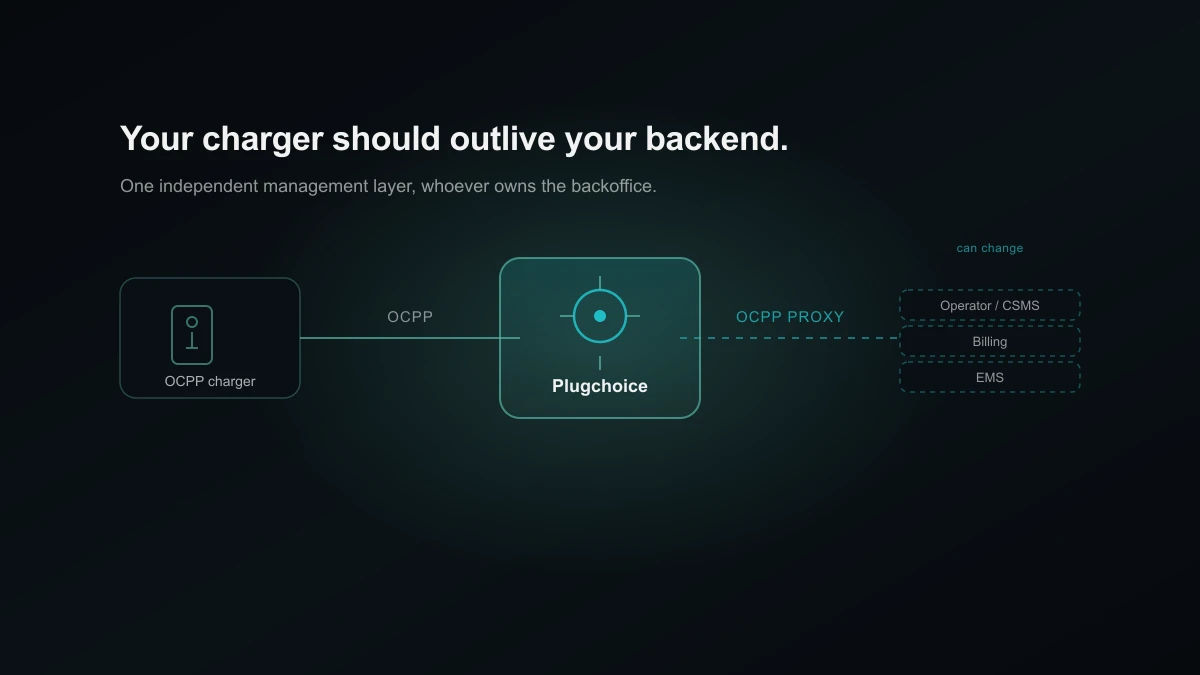
What is an OCPP proxy, and why would you put one between your charger and your backend
Most EV chargers can only talk to one backend at a time, so every platform switch means reconfiguring hardware. An OCPP proxy removes that constraint: it routes OCPP traffic to one or more platforms while the charger's configuration never changes. Here is what a proxy does, what you can route, and when it makes sense.
Protocols | Software

Peblar launches the Dual: a dual-socket charger for grid-constrained sites
Peblar has launched the Dual, a dual-socket AC charger that shares one grid connection between two Type 2 sockets, with a built-in card terminal and OCPP. Here is what it is, who it is for, and how it connects to Plugchoice.
Peblar | Hardware | Netherlands

Peblar Dual: was wir über den Doppelsockel-Charger wissen und wie man ihn verwaltet
Peblar enthüllt den Dual, einen AC-Charger mit zwei Steckdosen für halböffentliche und gewerbliche Standorte, am 23. Juni 2026 auf der Power2Drive in München. Hier steht, was wirklich bestätigt ist, was noch unbekannt ist, und wie der Dual als Backoffice an Plugchoice andockt, für Lastmanagement und Smart Charging.
Peblar | Hardware | Netherlands
AFIR für öffentliches Laden: die Daten- und Zahlungsregeln, und wie Sie sie ergänzen, ohne Ihr Backend zu ersetzen
AFIR legt EU-Regeln für Ad-hoc-Zahlung, Preistransparenz und offene Daten an öffentlich zugänglichen Ladepunkten fest. Hier erfahren Sie, was tatsächlich verlangt wird, für wen es gilt und wie Sie die fehlenden Teile über den Plugchoice OCPP Proxy zu einem bestehenden Backend hinzufügen können, statt es herauszureißen.
Regulation | Billing & payments | Europe

Landis+Gyr hat das EV-Laden verlassen. Ihre Ladepunkt-Cloud sollte einen Ausstiegsplan haben.
Landis+Gyr hat das EV-Laden in EMEA verlassen, das Etrel-Geschäft wechselte den Eigentümer und Ocean wurde als eigenständiges Unternehmen ausgegliedert. Der Ladepunkt an der Wand funktioniert meist noch. Die Cloud drumherum ist der Teil, der sich bewegt. Hier ist, warum Installateure, CPOs und Reseller auf migrationssichere OCPP-Architektur setzen sollten, und wie der kostenlose Plugchoice OCPP Proxy den Ladepunkt verwaltbar hält, wenn sich eine Plattform ändert.
Landis+Gyr | Ocean | Etrel | Software | Market | Europe

Enovates ist gefallen. Ihre Ladepunkte müssen es nicht.
Enovates ist zum Kontinuitätsrisiko geworden, nachdem Connect Group den Stecker gezogen hat. Der Ladepunkt an der Wand funktioniert oft noch. Die Plattform drumherum ist die Schwachstelle. Das sollten Installateure, CPOs und Betreiber jetzt prüfen, und so hält OCPP Enovates-Ladepunkte über Plugchoice verwaltbar.
Enovates | Hardware | Market | Belgium

Lekkerladen ist jetzt als ERE-Integration in Plugchoice verfügbar
Lekkerladen ist jetzt als ERE-Integration in Plugchoice verfügbar. Ladegerätebesitzer verbinden sich über die Plugchoice-App oder das Web-Portal, während Lekkerladen Plugchoice als Daten- und Reichweitenplattform für ERE-Registrierungen nutzt.
Lekker Laden | Energy | Software | Netherlands

Peblar fügt Plugchoice als Betreiber in seiner Weboberfläche hinzu
Installateure können Plugchoice jetzt direkt in der Peblar-Weboberfläche als Betreiber auswählen. Die Option ist ab heute in Firmware 1.9.0 + C1.15 verfügbar, auf allen Peblar-Ladestationen, und ist vollständig getestet und unterstützt, inklusive Smart Charging.
Peblar | Hardware | Software | Netherlands

Die evcc-App unterstützt jetzt Plugchoice für OCPP-Ladestationsverbindungen
Die evcc-App unterstützt jetzt Plugchoice als Weg, OCPP-Ladestationen anzubinden. evcc-Nutzer behalten ihr Solar- und Smart-Charging, während die Ladestation über Plugchoice verbunden und verwaltet bleibt.
evcc | Software | Germany

Easee-Ladestationen lassen sich jetzt mit wenigen Taps mit Plugchoice verbinden
Easee unterstützt jetzt Plugchoice als Operator. Installateure, CPOs und Wiederverkäufer bringen Easee-Ladestationen ohne technischen Umweg in der Plugchoice-Plattform online, direkt aus der Easee-App.
Easee | Hardware | Software | Norway

Laadloon ist jetzt als ERE-Integration in Plugchoice verfügbar
Laadloon ist jetzt als ERE-Integration in Plugchoice verfügbar. Ladepunktbesitzer können über die Plugchoice-App oder das Webportal verbinden, während Laadloon Plugchoice als Daten- und Exposure-Plattform für ERE-Registrierungen nutzt.
Laadloon | Energy | Software | Netherlands

Joulo ist jetzt als ERE-Integration in Plugchoice verfügbar
Joulo ist jetzt als ERE-Integration in Plugchoice verfügbar. Ladepunktbesitzer können über die Plugchoice-App oder das Webportal verbinden, während Joulo Plugchoice als Daten- und Exposure-Plattform für ERE-Registrierungen nutzt.
Joulo | Energy | Software | Netherlands
EV-Ladestationen nach Software-Kompatibilität auswählen: Was Installateure vor dem Kauf prüfen sollten
Nicht jede OCPP-Ladestation verhält sich in der Praxis gleich. Hier erfahren Sie, was Installateure vor dem Kauf von EV-Ladestationen tatsächlich prüfen sollten: von der Tiefe der Fernkonfiguration über den Zählerzugang bis hin zu Firmware-Unterstützung, Phasenumschaltung und Load-Balancing-Schnittstellen.
Hardware | How-to

MID-Zähler für EV-Laden: Wann brauchen Sie einen und wann nicht?
Ein praxisorientierter Europa-Leitfaden dazu, wann ein MID-Zähler für Erstattung, Abrechnung, niederländische ERE relevant ist und warum nicht jede kWh-Anzeige einer Ladestation für die Abwicklung ausreicht.
Hardware | Regulation | Europe

Warum Smart Charging über die Auto-API scheitert und warum OCPP gewinnt
Smart Charging über das Auto klingt clever, bis OEM-Beschränkungen, Rate Limits und Plattformänderungen im Weg stehen. Hier erfahren Sie, warum die Steuerung der Ladestation über OCPP in der Regel das sauberere, zuverlässigere Setup ist.
Software | Protocols | Energy

ISO 15118-1, -2, -3 und -20 erklärt: was jeder Teil tut und warum Plug & Charge, V2G-ready und echtes V2G nicht dasselbe sind
ISO 15118 wird überall im EV-Laden erwähnt. Hier erfahren Sie, was jeder Teil tatsächlich tut und warum Plug & Charge, V2G-ready und echtes V2G nicht dasselbe sind.
Protocols | Energy

Was ist OCPI und wie unterscheidet es sich von OCPP?
OCPI und OCPP werden ständig verwechselt. Dieser Artikel erklärt den Unterschied in verständlicher Sprache, zeigt, wo jedes Protokoll hingehört, und klärt, wann OCPI tatsächlich relevant ist.
Protocols

REST API, MQTT oder Dashboard: Wie sollten Sie EV-Ladestationen steuern?
Oft werden REST API, MQTT, Dashboards und OCPP verglichen, als ob sie alle denselben Job erledigen. Tun sie nicht. Hier erfahren Sie, wie Sie sie als Schichten betrachten und die richtige wählen.
Software | How-to

Niemand will zurück zum Standort fahren: Warum Remote-Sichtbarkeit, Konfiguration und Steuerung von EV-Ladestationen wichtig sind
Remote-Sichtbarkeit, Konfiguration und Steuerung sind das, was eine EV-Ladestation nach der Installation operativ nützlich hält. Hier erfahren Sie, warum Installateuren, Besitzern und Support-Teams so viel daran liegt, nicht zurück zum Standort fahren zu müssen.
Software

Wie OCPP das EV-Laden dominierte
OCPP wurde zum offenen Standard hinter modernem EV-Laden, weil es Ladestationen, Software, Abrechnung und zukünftige Upgrades flexibel hält. Hier erfahren Sie, woher es kam, warum es sich verbreitete und was die US-Regelung wirklich bedeutet.
Protocols

EV-Ladeabrechnung erklärt: Roaming, Ladekarten, CPOs und Backoffices
Ein verständlicher Leitfaden zur Funktionsweise der EV-Ladeabrechnung in Europa: von Ladekarten und Roaming über CPOs, Backoffices, OCPP, OCPI bis hin zu Plugchoice.
Billing & payments | Software

Wie OCPP Smart Charging Profile funktionieren und warum Plugchoice TxProfile verwendet
Eine praxisorientierte Erklärung der OCPP Smart Charging Profile, warum TxProfile transaktionsbezogen ist und wie Plugchoice es für dynamische Ladesteuerung einsetzt.
Protocols | Energy

ERE-Zertifikate erklärt: was sie sind, wie die Berechnung funktioniert und warum Sie sie nicht selbst registrieren können
Eine verständliche Erklärung von ERE-Zertifikaten für das EV-Laden: was eine ERE ist, wie die offizielle Berechnung funktioniert, warum Privatpersonen sie nicht selbst registrieren können und wo Plugchoice ins Bild passt.
Energy | Regulation | Netherlands

Was ist OCPP?
OCPP steht für Open Charge Point Protocol. Es ist die Sprache der EV-Ladestationen. Es besteht eine gute Chance, dass Ihre EV-Ladestation OCPP-konform ist, was bedeutet, dass Sie sie mit vielen verschiedenen Systemen für Bezahlung, Energiemanagement und mehr verbinden können.
Protocols

Was ist ein OCPP-Backoffice?
Ein OCPP-Backoffice, auch als OCPP-Backend, Plattform oder CSMS bezeichnet, ist eine Datenbank, in der Sie Ihre Ladestationen sehen und deren Status prüfen können.
Software | Protocols
