A charger can be perfectly fine on the wall and still become a headache because the cloud around it changed.
That is the part people tend to underestimate.
When Landis+Gyr announced in February 2025 that it would wind down and exit its EV charging business in EMEA, the immediate market reaction was predictable. Customers and competitors started talking about OCEAN EV, Etrel chargers, support, repairs, upgrades and migration paths. Industry press covered the withdrawal within days. Not exactly a calm Tuesday.
But the useful lesson is not "never use Landis+Gyr" or "Ocean disappeared." That would be too easy, and not really fair.
The actual story is messier. Better too.
Landis+Gyr said it was leaving the EV charging business in EMEA after market conditions, regulation and competitive pressure made the business hard to justify. A month later, KD Group bought the EV Solutions business, formerly Etrel, and the messaging shifted toward continuity for employees, customers and partners. Etrel later said KD Group's investment ended the liquidation process. Then Ocean was carved out as a separate company, with customer relationships and data responsibilities transferred.
So no, this is not a simple "platform went dark overnight" story.
It is more useful than that.
It is a case study in what happens when the company behind a charger cloud changes direction, changes owner, splits a platform, or forces customers to rethink who actually controls the charger connection. It is the same pattern we saw when a charging backend changes direction and when a manufacturer collapsed and chargers risked getting stranded.
The charger is not always the risky part
Installers and CPOs often talk about hardware risk: broken sockets, failed RFID readers, unavailable spare parts, firmware bugs, warranty handling. Fair. Those things matter.
But with modern EV charging, the more boring dependency is often the one that hurts first: the backoffice. If you want the plain-English version of what that layer even is, we wrote what is an OCPP backoffice.
Who owns the live OCPP connection?
Who can change the endpoint?
Who has the logs?
Who can export cards, sessions, tariffs and site data?
Who can keep billing running while another system is tested?
That is where OCEAN and Etrel became interesting for the rest of the market. Not because every customer was stranded in the exact same way. They were not. It became interesting because everyone was reminded, a bit loudly, that a charger cloud is part of the asset risk.
A wallbox with an open protocol can still become awkward if nobody has access to the right dashboard. A CPO with a working billing setup can still get nervous if support, ownership or product direction changes. A reseller can still get caught in the middle when a customer asks: "Is my charger still future-proof?"
That is a fun conversation. Said no reseller ever.
What "migration-proof" actually means
Migration-proof does not mean nothing ever changes. That is fantasy.
It means the charger is not trapped when something changes.
For installers, that means being able to keep visibility after the install. If a customer wants a billing platform, fine. If that platform changes later, also fine. The installer should not lose diagnostics, OCPP logs and remote configuration just because someone else owns the commercial operator relationship.
For CPOs, it means being able to test or swap systems without turning every charger into a mini field project. If billing, roaming, smart charging, support tooling or reporting needs change, the charger should not be the hostage. The whole point of remote management is that you do not drive back to site every time the cloud moves.
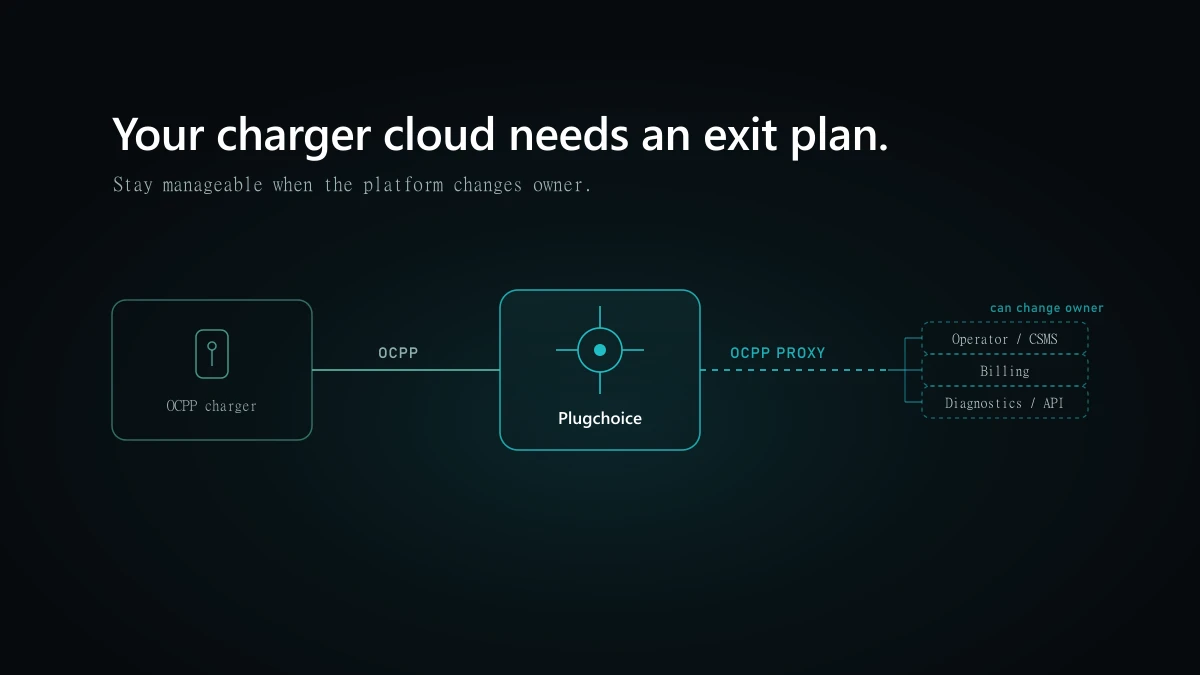
For resellers, it means selling hardware with a cleaner story: the charger can connect to Plugchoice first, then route to the chosen operator through the OCPP Proxy. The customer still gets choice, and the reseller is not stuck defending one backend forever. It is also why picking chargers for software compatibility pays off long after the install.
That is the difference between "this charger supports OCPP" and "this operation is actually built around portability."
One is a checkbox. The other saves weekends.
Where Plugchoice fits
The Plugchoice OCPP Proxy is built for exactly this kind of awkward market reality. OCPP itself is the reason any of this is possible. The Open Charge Alliance maintains it as the global open protocol between chargers and management systems, and it is how OCPP came to dominate EV charging in the first place.
Instead of connecting a charger directly to one billing or backoffice platform and hoping that platform never changes, the charger connects to Plugchoice. From there, Plugchoice can route OCPP traffic to another operator or backoffice while keeping Plugchoice available for management, diagnostics, logs, configuration and API access.
The practical bit: Plugchoice can run in parallel with the existing setup.
So a CPO can keep the current billing platform connected while adding Plugchoice as the management layer. An installer can keep remote support access without asking the customer to give up their operator. A reseller can offer a migration-proof setup without pretending there will never be a migration. The same logic extends across the hundreds of chargers, meters and platforms in the integrations list.
And the OCPP Proxy is free in every Plugchoice account. No per-charger proxy fee. No hidden migration-proofing tax. The word "free" gets abused a lot in software, but here it is unusually simple: connect the charger, keep your options open. You can see exactly what is included on the pricing page.
A fair note about Ocean
The honest version matters here.
Ocean is not something to describe as gone today. After the Landis+Gyr exit announcement and the KD Group and Etrel transaction, Ocean was later carved out as a separate company. Its own site presents Ocean as an active OCPP-compliant EV charging platform for operators, with its own team and customer-facing proposition.
That does not weaken the point. It strengthens it.
Because the point is not that Ocean failed and everyone else should clap. That would be lazy. The point is that the market changed around customers, and customers had to understand the implications quickly. Exit announcement, acquisition, transition period, platform carve-out, customer relationship transfer: those are business events, but they land as operational questions for installers and CPOs.
Who supports my charger?
Who controls the platform contract?
Where is the data?
Can I move if I need to?
Can I keep running while I decide?
That is the whole game.
What to check before the next platform surprise
Start with the boring list. Boring is good. Boring prevents panic.
For every charger fleet, especially mixed fleets, check:
- Which platform owns the active OCPP connection
- Who can change the OCPP endpoint remotely
- Whether the charger can be routed through a proxy
- Whether session history, cards and site data can be exported
- Whether support teams can see raw OCPP logs
- Whether billing can continue while another management layer is added
- Whether installers, CPOs and resellers all know who owns which part of the stack
This is where many setups look open on paper but brittle in practice. The charger may support OCPP, yes. But if the endpoint is locked, credentials are missing, or only one party has admin access, the migration is not a migration. It is detective work with a customer waiting.
Nobody wants that.
The real takeaway for installers and CPOs
The Landis+Gyr and OCEAN story is not a neat little shutdown tale. It is a reminder that EV charging companies change. Product lines get sold. Platforms get carved out. Support obligations move. Strategies shift. Sometimes the outcome is fine. Sometimes it is messy. Usually, it is unclear right when customers most want certainty.
That is why Plugchoice is built around choice rather than blind platform loyalty.
Use Plugchoice as the layer that keeps the charger manageable. Route to the billing platform your customer needs. Keep diagnostics and logs available. Keep API access open. Keep the ability to disconnect or switch operators later.
Get Plugchoice. Put the free OCPP Proxy between your chargers and the rest of the market. If you run a larger network, talk to Plugchoice or contact us before a platform change becomes urgent.
Not because every platform is going to disappear.
Because enough of them change. And when they do, the charger on the wall should not be the thing holding everyone hostage.
Sources and useful links
- Landis+Gyr strategic update on exiting EV charging in EMEA, the primary source for the decision and rationale
- Landis+Gyr EV Solutions transaction with KD Group, the sale of the former Etrel business and continuity wording
- Etrel: a new chapter begins, Etrel on the KD Group acquisition ending the liquidation process
- Etrel: the Ocean carve-out, the separation of Ocean with customer relationships and data responsibilities transferred
- Ocean EV Charging Platform, Ocean presenting itself as an active OCPP-compliant platform today
- Electrive: Landis+Gyr withdraws from charging infrastructure, independent industry coverage of the exit
- Open Charge Alliance: OCPP, the authoritative protocol definition
- Plugchoice OCPP Proxy, Web Portal, REST API and integrations, the routing and management layer
- Plugchoice for installers and for charge point operators, the audience pages
- How OCPP came to dominate EV charging, Enovates continuity and backend lock-in at Blink Charging, related Plugchoice context