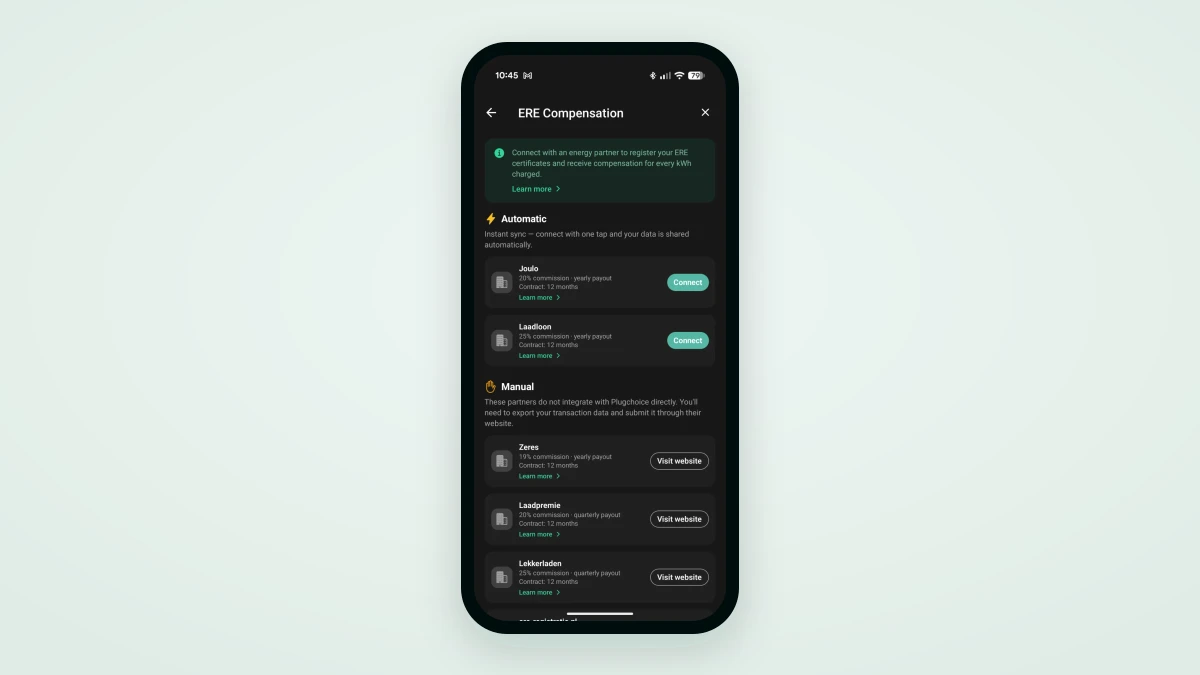
Laadloon is now available as an ERE integration in Plugchoice. Charger owners can choose Laadloon from the Plugchoice app or web portal, authorize the connection once, and let eligible charging sessions flow through Plugchoice as the data layer behind the ERE process.
The useful part is not just that another name has been added to the ERE list. Laadloon chooses Plugchoice as its data and exposure platform. That means customers can find Laadloon inside Plugchoice, while the technical work around charger data, sessions and authorization stays in one place.
ERE works best when the boring parts are handled well
ERE is the Dutch system for green energy certificates in transport. ERE stands for emissiereductie-eenheid, or Emission Reduction Unit, where one unit equals one kilogram of CO2-equivalent emissions saved. Eligible EV charging sessions are registered as these units. They can then be traded in a regulated market, with revenue flowing back through the chain. We unpacked the mechanics in ERE certificates explained, and the official rules live with the Nederlandse Emissieautoriteit.
That sounds simple until the actual chain starts. A charging session needs usable kWh data, timestamps, meter information, a clear authorization from the charger owner, verification and a booking provider that understands the rules. When any of those parts become messy, ERE quickly turns into an admin project instead of a useful proposition. The NEa even publishes separate guidance on registering electricity for private users, which shows how much process sits behind a single kWh.
Plugchoice keeps that operational layer together. The customer chooses the booking provider, Plugchoice normalizes the charging data across every charger brand, and the inboekdienstverlener receives the data stream it needs. CPOs and installers can offer ERE to their customers without becoming ERE specialists themselves.
What Laadloon adds
Laadloon focuses on making ERE understandable for charger owners: charge through the existing charger, have the usage processed, and receive a payout when the ERE value is sold. Laadloon also positions the service around no lock-ins, transparent handling and compliance experience. Laadloon is a trade name of Compliance2Cash B.V., and you can see exactly how the connection works in Laadloon's own Plugchoice flow.
Laadloon.nl is listed by the Dutch Emissions Authority in its overview of inboekdienstverleners. That source is useful context, but it also needs the usual nuance. The NEa states that being listed does not mean a party has a REV account, has been quality-assessed, or has been approved or accredited by the NEa. Responsibility for correct registration remains with the inboekdienstverlener itself.
That nuance matters. ERE is not just a marketing label. It is an administrative and technical process where the data trail needs to make sense, especially when it later has to be checked. For charger owners, the practical question is simple: can they connect without manual exports, strange workarounds or a new technical setup?
With the Laadloon integration, the answer is designed to be straightforward. The customer connects through Plugchoice, Laadloon receives the relevant data for the ERE process over the REST API, and the charger remains managed from the Plugchoice app or web portal. No separate news-worthy magic. Just less operational friction, with no OCPP migration required.
Why this matters for CPOs and installers
For CPOs and installers, ERE is interesting because it can turn an existing charger base into a recurring value proposition. The difficult part is not explaining that customers may earn from eligible charging. The difficult part is making it clean enough to actually offer at scale.
Plugchoice gives them that layer. The charger owner chooses the ERE provider, the data stays structured in one platform, and the booking provider handles the ERE side. When there is revenue, CPOs and installers can participate through the Plugchoice Partner Program instead of manually coordinating every customer, meter and provider themselves. It is the same open, hardware-agnostic approach behind recent connections like Joulo, Easee, Peblar and the evcc app.
For ERE booking providers, the logic works the other way around. Instead of building a separate route to every CPO, installer or charger brand, they can become visible inside Plugchoice and receive standardized charging data through one platform. That is the exposure part of the integration. Providers that want to explore it can start from the Plugchoice ERE proposition or contact us directly.
Compare before you connect
Commercial conditions around ERE providers can differ, and they can change. That is why detailed commercial information for Laadloon sits in Laadloon's own Plugchoice flow, while the broader comparison lives in the ERE integrations overview. A news article is not the right place to freeze pricing or terms in time.
Laadloon is available in Plugchoice as of 29 April 2026. Charger owners can connect from the Plugchoice app or web portal. CPOs, installers and ERE booking providers that want to understand the full model can start with the Plugchoice ERE proposition, browse the wider integrations overview, or get started for free.
Sources and links
- Plugchoice ERE proposition
- Plugchoice ERE integrations overview
- Laadloon Plugchoice flow
- Laadloon public website
- NEa list of inboekdienstverleners
- NEa: Hernieuwbare Energie voor Vervoer
- NEa: registering electricity for private users
- Nederlandse Emissieautoriteit (NEa)
- Joulo is now available as an ERE integration in Plugchoice, a companion integration announcement
- ERE certificates explained, a background article