Blink Charging is restructuring hard, and that is not rumor. Blink itself announced a global workforce reduction of roughly 20% under its BlinkForward plan, and later SEC filings describe further operational changes, including a completed move to contract manufacturing and no in-house manufacturing facilities after January 2026.
That matters in Europe, because Blink is not some distant American charging brand. In 2021, Blink acquired Blue Corner, the Belgian EV charging operator with more than 7,000 charging ports across Belgium, Luxembourg, the Netherlands and France. In 2023, Blue Corner was brought under the Blink Charging brand. For many customers, the old Blue Corner world quietly became the Blink Charging Belgium world. And that is where charger owners should pay attention.
Blink is restructuring, and it reaches Belgium
Public filings do not prove that Blink Charging Belgium or the former Blue Corner operation is being shut down completely. In fact, Blink's Belgian EVA Portal is still online and still describes charger management, charge cards, support requests, charging data, reports, uptime monitoring and remote access, and the Blink Belgium support site still references EVA as the client platform.
So the point is not "Blink is gone." That would be too easy, and it is not properly supported by the sources. The point is sharper than that. A charging backend can change direction long before the physical charger on the wall reaches the end of its life. Blink's own 2025 annual report shows the Blue Corner and Blink UK reporting units had their goodwill fully impaired as of the end of 2024. The hardware kept charging. The strategy around it moved.
The risk is bigger than any one company
This is the part most people underestimate. The charger may still be there. The cable may still click in. The LEDs may still turn on. But the useful layer around it can change overnight: portal access, session insight, reimbursement flows, remote support, diagnostics, operator routing, reporting and user management.
For a private driver, that is annoying. For an installer, a charge point operator, a fleet manager or a property operator, it is a business risk. The professional charging market is growing up. Installers are no longer just placing hardware. CPOs are no longer just watching a map. Fleet and property operators expect charging to behave like infrastructure, not like a fragile app subscription that can be re-scoped from a head office on another continent.
The Belgian home-charging noise is a warning shot
We also found third-party Belgian pages and posts claiming that Blink Charging Belgium is stopping support for home charging infrastructure from 31 May. MobilityPlus has a public landing page aimed squarely at Blink customers that says exactly that, and Blulinc has published LinkedIn posts targeting affected Blink home-charging users.
To be fair, we did not find an official Blink customer notice confirming the home-charging stop in public sources, so it should be treated as a third-party claim unless a customer letter or direct Blink notice is available. But even with that caveat, the market reaction is clear. Competitors are already moving toward Blink home-charging customers and selling continuity, migration and control. That alone should make every charger owner ask one simple question. If the company behind your backend changes strategy, who still controls your chargers?
Hardware freedom without backend freedom is not freedom
OCPP, the Open Charge Point Protocol maintained by the Open Charge Alliance, was supposed to prevent this problem. In theory, an OCPP-compatible charger can talk to different charging backends. In practice, many installations still end up stuck in one operational setup, because the portal, card logic, billing routes, smart charging settings, support tooling and customer data all live in a single backoffice. That is not real freedom. That is dependency with a protocol underneath.
If the platform changes, the chargers should keep working. If an operator contract ends, management should not disappear. If a billing provider is replaced, diagnostics should not vanish with it. If a customer wants to test another backend, that should not require a painful platform migration project. This is the practical reason Plugchoice exists.
How Plugchoice keeps the charger layer independent
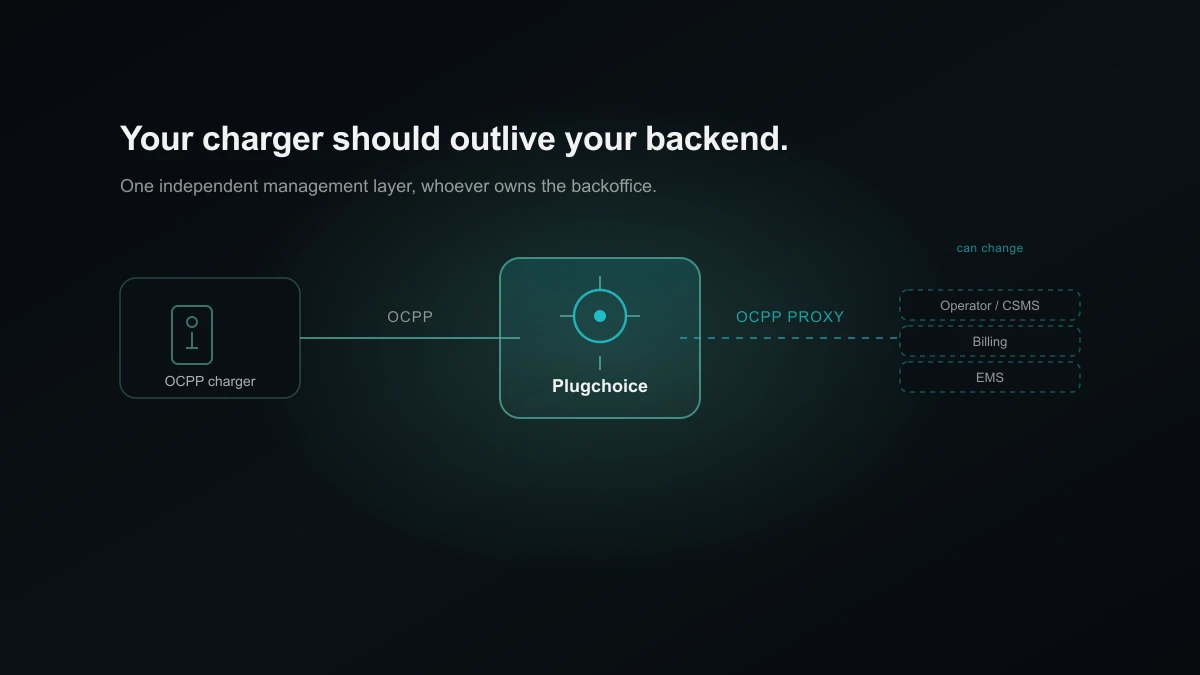
Plugchoice connects directly to OCPP chargers and gives charging professionals one management layer across brands. The web portal, app, diagnostics and OCPP logs, configuration, support tools and REST API all stay available through Plugchoice, no matter which charger brand sits on the wall. That is the same open, brand-agnostic thinking that already lets Easee, Peblar and the evcc app run side by side in one fleet.
The important part is the OCPP Proxy. With the Plugchoice OCPP Proxy, chargers can stay connected to Plugchoice while OCPP traffic is routed on to an external operator, billing platform, CSMS or EMS. That means the commercial backoffice can change without throwing away the operational layer. In plain language: you keep managing the charger while choosing who gets the OCPP connection.
That matters when things go wrong, and it also matters when things go well and you simply want more options. Need billing through an existing CPO? Route it. Need analytics somewhere else? Add it. Want to disconnect a platform later? The charger stays manageable in Plugchoice. Want to test a different operator? You do not need to start from zero. This is where OCPP stops being a checkbox and becomes leverage. If you want the longer argument for why controlling the charger beats controlling the car, our piece on why smart charging through the car API breaks makes the same case from a different angle.
The safer question to ask before you install a charger
The old question was "Which charger should we install?" The better question is "Can we still control this charger if the backend changes?" For installers, that question protects your customer and your support team. For CPOs, it protects operational continuity. For fleet and property operators, it protects the investment behind the wallbox or charging station.
A charging installation is supposed to last years. Backend strategies, acquisitions, pricing models and service scopes can change much faster. That gap is exactly where lock-in hurts, and it is the gap a proxy is built to close.
What to do now
If you manage chargers today, do not wait until a provider sends a shutdown, migration or price-change email. Check three things first. Which of your chargers are actually OCPP-compatible? Who controls the OCPP endpoint today? And what would happen if the current platform stopped supporting your use case tomorrow? If the answer to that third question is vague, that is the risk.
Plugchoice gives you a cleaner setup: one independent management layer for your chargers, with OCPP Proxy routing to the operator or backoffice that fits your business. And it is free to start, with charger management, the web portal, the app, OCPP Proxy, basic REST API access and OCPP logging included, so there is no per-charger platform fee just to keep your own hardware usable. Explore the OCPP Proxy, browse the integrations overview, get started for free, or contact us about a specific fleet. Your backend choices should stay choices. They should never become a trap.
Sources and links
- Blink Charging acquires Blue Corner, the 2021 acquisition and port count
- Blue Corner becomes Blink Charging, the 2023 rebrand
- Blink workforce reduction announcement, the BlinkForward restructuring
- Blink 2025 annual report, Blue Corner and Blink UK goodwill impairment
- Blink Q1 2026 filing, the move to contract manufacturing
- Blink EVA Portal and the Blink Belgium support site, both still live
- MobilityPlus Blink migration page and Blulinc on LinkedIn, third-party market-signal claims
- Open Charge Alliance and OCPP 1.6, the organisation and protocol behind it all
- Plugchoice OCPP Proxy, the independent management and routing layer
- Plugchoice integrations overview, supported chargers, operators and platforms
- What is OCPP? and What is an OCPP backoffice?, background reading