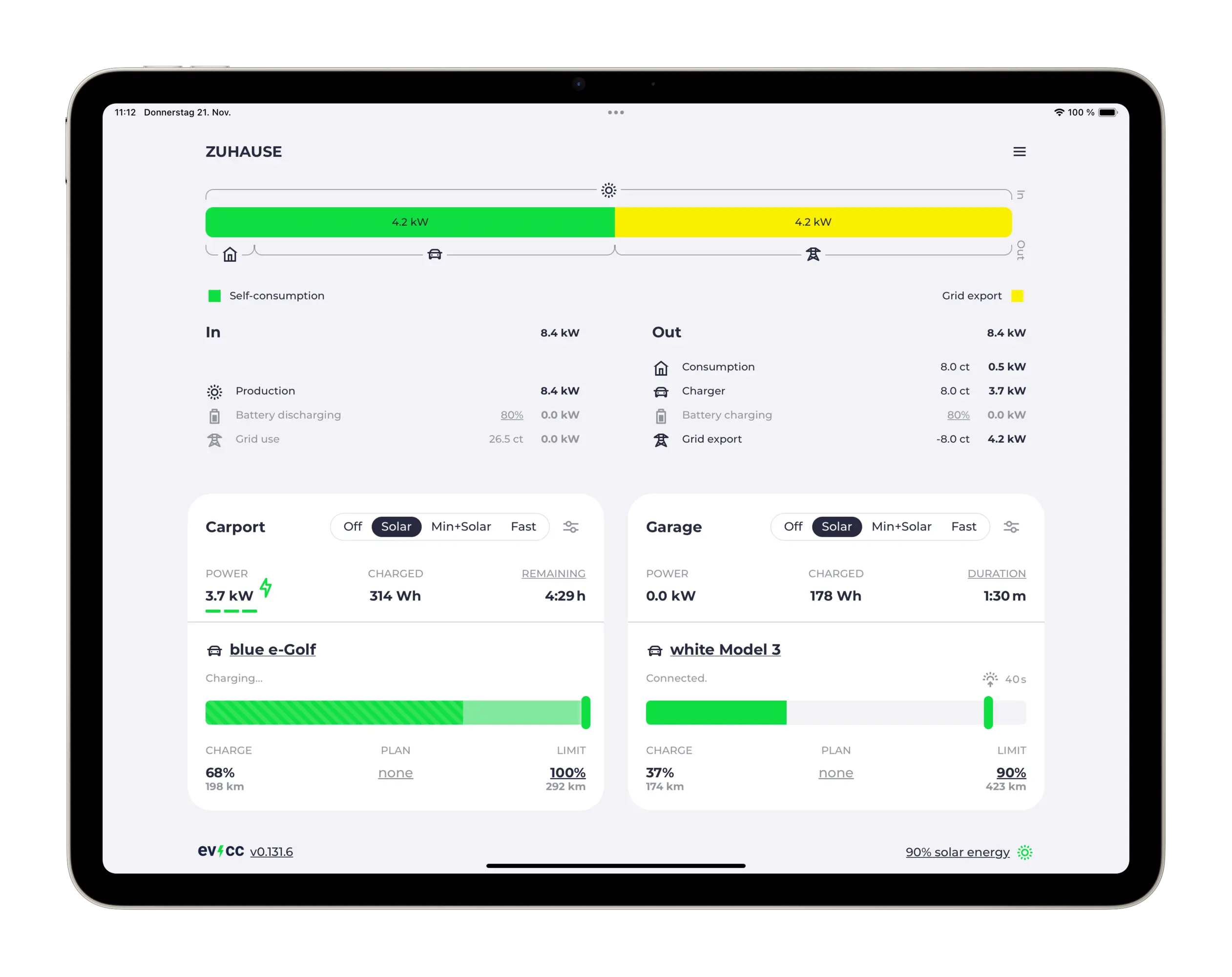
The evcc app now supports Plugchoice as a way to connect EV chargers that speak OCPP. Once a charger is online in the Plugchoice platform, it can be selected directly inside evcc. The connection is documented on the Plugchoice evcc integration page and in the evcc charger list.
For installers, charge point operators and resellers, that is the practical part. A customer who runs evcc for solar surplus charging or dynamic-tariff charging can keep doing exactly that, while the charger stays connected to, configured in and monitored through Plugchoice. One less special case to handle, one less charger brand to rule out, and one cleaner answer when someone asks whether their setup will actually work.
What changes for evcc users
evcc has built a serious following among technically minded EV drivers, solar owners and home energy enthusiasts. It is an open-source charging and energy management project with a simple but demanding goal: charge the car when it makes the most sense. In practice that means following solar surplus, reacting to dynamic electricity prices, and coordinating chargers, vehicles, meters and home batteries from one place, all running locally rather than in someone else's cloud.
The recurring catch has always been hardware. evcc already works with hundreds of devices, but whether a specific charger behaves well depends on how completely it implements OCPP and how it is connected. With Plugchoice now available as a connection option, an OCPP charger that is online in the Plugchoice platform can be picked in evcc without a vendor-specific detour. Plugchoice normalizes the OCPP side across charger brands, and evcc handles the energy logic on top.
The two stack rather than compete. Plugchoice runs an OCPP proxy, so a charger can stay connected to Plugchoice for remote configuration, diagnostics and day-to-day management and still be controlled through evcc at the same time. Nothing has to be unplugged from one system to be used in the other.
Why this matters for installers and CPOs
For installers and CPOs, the value is concrete. A customer who wants to use evcc is no longer treated as an exception by default. The charger is commissioned onto Plugchoice the same way as always, the installer keeps remote visibility and control through the web portal, and evcc sits on top as the energy layer the end user actually opens every day.
That separation is the point. Installers and CPOs care about reliable remote management, firmware, diagnostics and a clean OCPP backoffice. End users care whether the car charges on sunshine and whether it is cheap. With this integration, both groups get the tool that fits them, working through the same physical charger. The Plugchoice app and portal stay available for everything evcc does not cover, from charge cards and transactions to power management and tariff management when a site needs it.
An integration that fits an open, OCPP-first market
The EV charging market is still fragmented. Different chargers, different apps, different installers, different expectations. Most of the friction is not one big technical problem; it is the small handovers that have to line up. evcc is proof of how much demand there is for smart charging that the user actually controls, rather than charging logic locked inside a car maker's API.
Plugchoice's job is to make sure the charger underneath stays reachable, by whatever tool the user picks. That is why the platform is hardware-agnostic and OCPP-first: OCPP, maintained by the Open Charge Alliance, is the open standard that lets chargers, software and energy tools interoperate, down to details like smart charging profiles that keep controlled charging predictable. Connect a charger to Plugchoice once, and it can talk to a growing list of integrations, now including evcc alongside names like Easee. For teams that want to build their own logic, the REST API stays open too.
Working with evcc users? Here is where to start
Installers, CPOs and resellers can now offer evcc compatibility as a normal part of a Plugchoice setup, not a workaround. Connecting a charger to Plugchoice is free, and from there it is ready for evcc and the rest of the platform.
Want to see what Plugchoice offers around connection, operation and charging services? Start with the evcc integration page, browse the wider integrations overview, check the pricing page, or get started directly. Building something more custom on top? The developer side is open. evcc users can install the app from the evcc website or GitHub, try the public demo first, and follow the evcc installation guide. Questions specific to your fleet? Contact us.
Sources and links
- evcc documentation: the Plugchoice charger connection
- evcc website
- evcc on GitHub
- evcc dynamic tariffs documentation
- Open Charge Alliance, the organisation behind OCPP
- Plugchoice evcc integration page
- Plugchoice integrations overview
- What is OCPP?
- Easee chargers can now connect to Plugchoice, a companion integration announcement