Search for a free OCPP server and most results turn out to be free in a limited sense: a trial that ends, a cap on how many chargers you can connect, or a core feature held back until you pay. That is a reasonable way to run a business, but it makes "free" mean something different from what it says.
Plugchoice's platform is free in the plain sense: no trial period, no charger limit, and no credit card to start. The question worth answering honestly is what that actually covers, and where the paid parts of the product begin, since a vendor that will not say that clearly is usually hiding a catch.
What the free platform includes
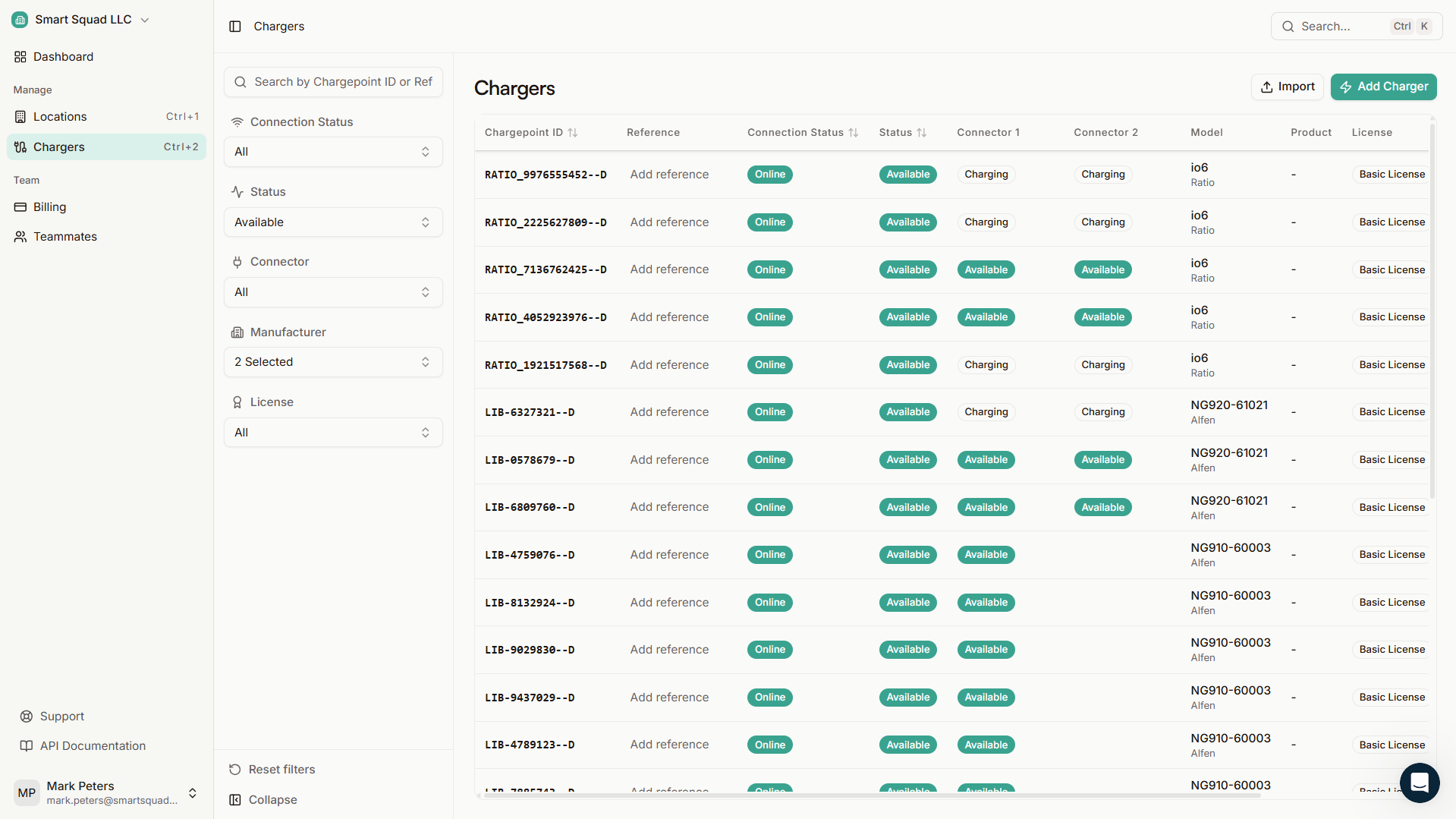
The free tier is not a stripped-down entry point, it is the platform. Every charger you connect, however many, gets full charger management: real-time status across every site, remote lock and unlock, start and stop, and Plug & Charge autostart. Setup and firmware live here too, remote configuration, pre-commissioning before you ever reach the site, and firmware management, plus full OCPP logging with CSV and Excel export and automatic error categorization when something goes wrong.
Card and team features are included, not upsold: charge card and RFID management, transaction history, team accounts with roles, and two-factor authentication. You get all three ways of touching the system, the web portal, a mobile app for drivers and installers, and a REST API with access tokens, at no extra cost.
The OCPP proxy to more than 300 operators is part of the free tier as well, which matters more than it sounds: it is what lets a charger run on Plugchoice's free management layer while staying connected to an existing billing or CSMS platform, rather than forcing a full switch before you get any of this. Dynamic load balancing across chargers on a shared connection is included too, not sold separately as a smart-charging feature.
None of this is time-boxed. It runs for as long as the charger is connected, on any brand, because Plugchoice normalizes every OCPP charger into the same system regardless of manufacturer.
What is not free, and who pays for it
Two things sit outside the platform, each its own paid module, each billed per charger rather than per account.
Smart Charging, solar balancing, power sharing across chargers, peak shaving, and charging on dynamic energy tariffs, costs €25 a year, €74 for five years, or €165 as a one-off license per AC charger (DC chargers count double), excluding VAT. Billing & Invoicing, turning sessions into itemized invoices and handling reimbursement and cost allocation, is €5.95 a month per charger and is due to arrive in Q4 2026.
Both are opt-in per charger, and whoever owns that charger decides whether to pay: a driver charging at home, an employer offering workplace charging, or an operator running a site. Nobody pays for a module they never activate, and the free platform works exactly the same with or without either one switched on.
There is a third, separate cost that is not a per-charger module at all: the Partner Program, a flat €29 a month per company for installers and charge point operators who want a whitelabel portal, revenue sharing on the modules their customers activate, and priority support. It is optional, and it is priced per company rather than per charger, which is a different shape of cost from the two modules above.
Why the model holds together
A free CSMS with no charger cap only works if something else in the business actually earns revenue, and here that is the paid modules and the Partner Program, not the connection itself. That is a deliberate choice: charging infrastructure gets more useful the more of it is actually connected and managed well, so the core system is priced to remove any reason not to connect a charger, and the money comes from the features people choose to add once it is.
It also means the free tier is not a funnel toward a forced upgrade. There is no seat count that runs out, no feature that quietly becomes "premium" after a few weeks, and nothing that stops working if you never touch Smart Charging or Billing. The pricing page lists the current numbers for anyone who wants to check them against what is written here, since prices are the one thing worth re-checking rather than taking on faith.