Smart charging is one of those terms that sounds precise and is not. Every charger brand and every backend claims to do it, but the word covers three genuinely different mechanisms, and a vendor rarely says which one it means. That vagueness is not an accident: "smart charging" sells better as a single idea than as three separate features with three separate purposes.
Strip the marketing away and almost everything sold as smart charging is one of three things, usually combined on the same site: load balancing (including peak shaving), solar surplus charging, and price-based charging. They solve different problems, and knowing which one you actually need changes what you should be evaluating.
Load balancing and peak shaving
Load balancing answers a simple question: what happens when several chargers share one grid connection and the building needs power too?
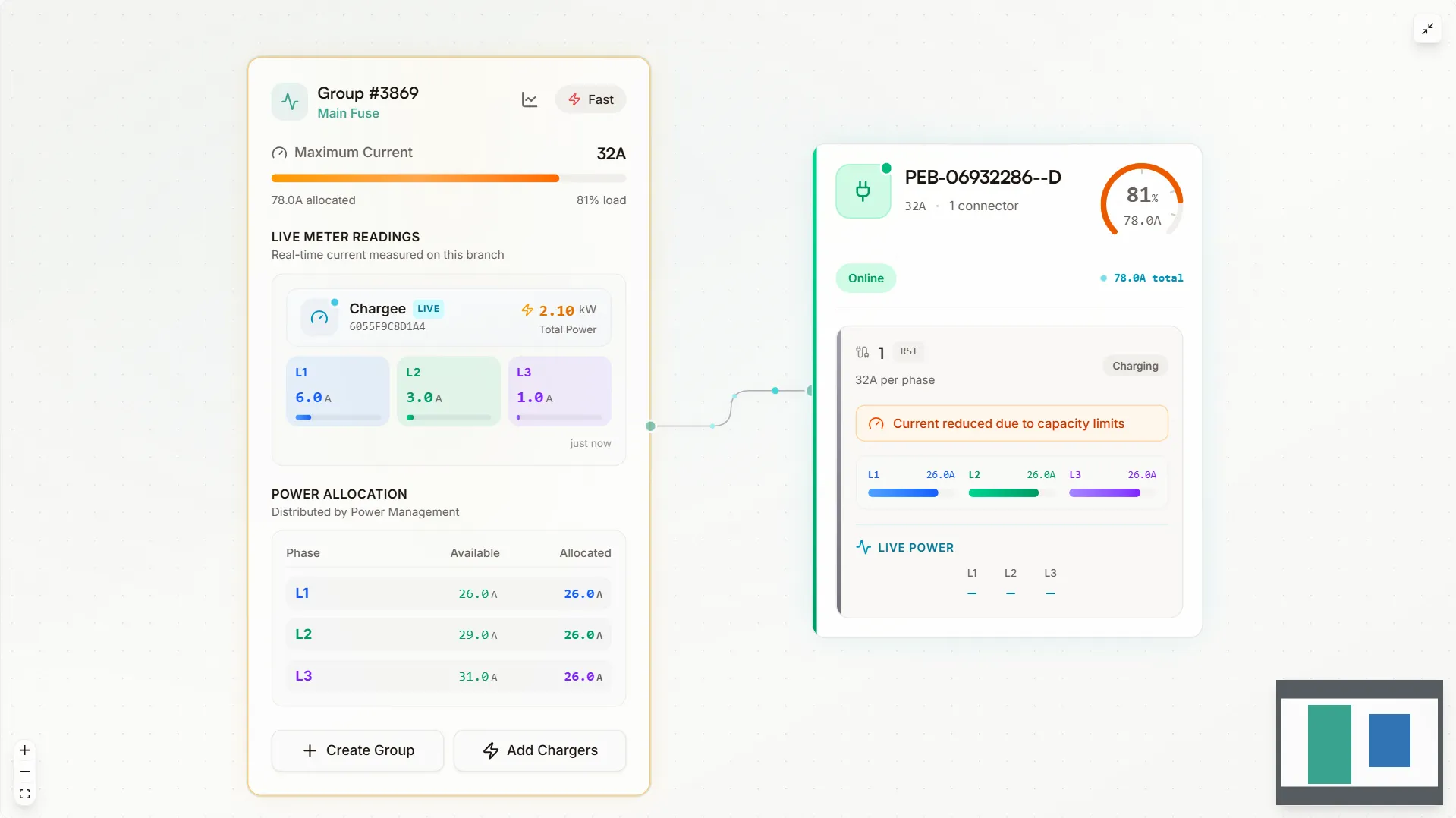
A site has a fixed capacity, usually set by the building's fuse or the grid connection agreement. Without balancing, every charger just pulls as much current as it can, and if the kitchen equipment, HVAC and three cars all draw at once, the site risks tripping the main fuse. Load balancing divides the available current across the active charging sessions instead of letting each one draw independently, and peak shaving is the specific case of the group throttling down when the building's own consumption rises, so the site total stays under its threshold.
In practice this can run on a static limit (a fixed number of amps the group never exceeds) or a dynamic one, where a live meter reading feeds the calculation and the available headroom shifts through the day as the building's own load changes. Three-phase installations complicate this further, since L1, L2 and L3 do not always draw evenly, so a system that only balances the total current can still overload a single phase. A charger that loses its balancing signal, because of a connectivity drop or a meter outage, needs a safe fallback value to fall back to rather than defaulting to full power.
Solar surplus charging: two different modes
Solar charging usually gets sold as one feature, but it splits into two modes with opposite trade-offs.
The first, sometimes called Solar Only, charges purely from what the site's solar panels are producing beyond the building's own consumption. Sessions start when there is enough surplus and pause when a cloud passes or the sun sets. It is the greenest option, but it is also the slowest and least predictable, since charging speed depends entirely on the weather.
The second mode, often called Smart Solar, uses solar production first and tops up from the grid to hold a minimum charging speed. This trades some of the pure-solar benefit for a session that actually finishes on a predictable schedule, which matters if the car needs to be full by morning regardless of cloud cover.
Both modes need a meter that reports solar production back to the system, not just consumption, and they work independently of the inverter brand: the system reads the meter, not the panels.
Price-based charging
The third mechanism is not about capacity at all, it is about cost. With a dynamic energy contract, the price of electricity changes hour by hour based on day-ahead spot prices from exchanges like EPEX or Nord Pool. Price-based charging holds a session until the price drops below a threshold, either one set manually or picked automatically from the day's price curve, so the car charges during the cheapest hours instead of whenever it happens to be plugged in.
A simpler variant works for fixed time-of-use contracts rather than live spot prices: define a window (say, midnight to 6 a.m.) and only allow charging inside it. Less precise than reacting to the actual spot price, but it needs nothing beyond knowing the contract's cheap hours.
How it actually reaches the charger
All three mechanisms run on the same underlying loop, and it is worth understanding because it explains both what smart charging needs and where it can fail safely.
A wireless energy meter at the grid connection or the solar inverter reports live readings to the cloud platform. The platform combines that reading with the group's configured limits and the user's settings, and calculates how much current each charger in the group is allowed right now. That decision reaches the charger as a standard OCPP charging profile, the same mechanism every OCPP-compliant charger already understands, so nothing proprietary needs to be installed on the hardware side. If the meter data or the connection drops, the charger falls back to a pre-configured safe value instead of guessing, so a lost signal never turns into an overloaded fuse.
That loop, measure, decide, adjust, is also why none of this needs control wiring between the meter and the charger. The meter talks to the cloud, the cloud talks to the charger over the same OCPP connection it already has. No on-site controller, no rewiring an existing installation to add the feature later.
Any OCPP charger, no rebuild required
Because the intelligence sits in the platform rather than the charger, none of these three mechanisms require a specific charger brand. Plugchoice runs load balancing, solar balancing and price-based charging as a cloud layer over any OCPP-compatible charger, AC or DC, and through the OCPP proxy it can add that layer on top of a charger that stays connected to an existing billing or CSMS backend, rather than requiring a full switch. The core platform is free for every connected charger; Smart Charging is the paid module on top, priced per charger on the pricing page.
The mechanics are the same whichever vendor implements them. What differs between platforms is how many of the three a given product actually supports, how the meter connects, and whether adding it later means new hardware or just a subscription. A full walk-through of how Plugchoice runs these three mechanisms in practice is on the smart charging page.